Japanese tattoos, a tradition of centuries on skin
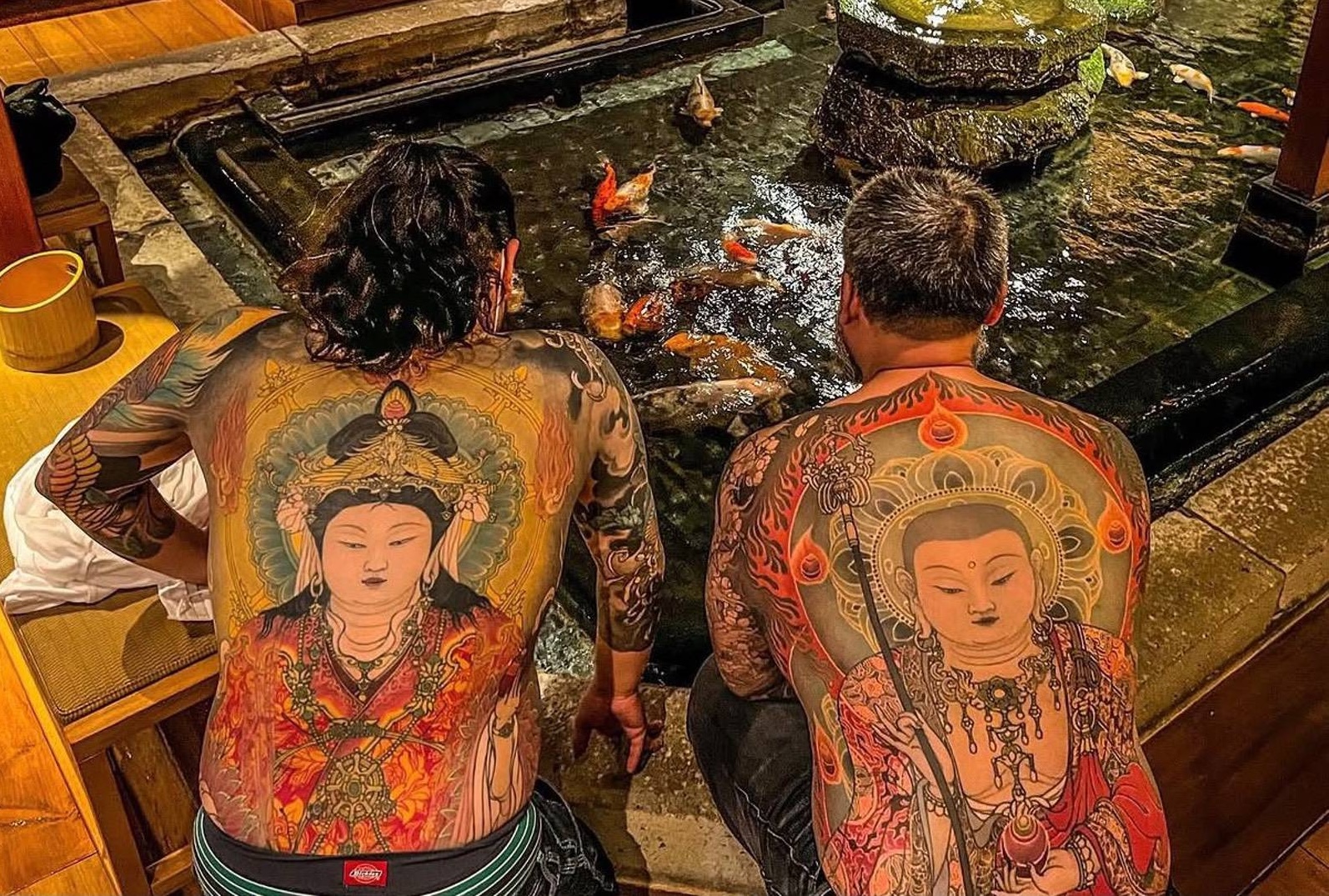
A Japanese tattoo isn't a picture. It's a story flowing across a back, a mythology stretching from shoulder to calf, a deliberately chosen scene that sometimes claims the entire body. No other tattoo style carries this much history, symbolism, and cultural weight. And few styles remain as recognisably Japanese as irezumi, even a hundred years after being drawn outside Japan.
Irezumi (入れ墨) is the Japanese term for tattooing in the traditional style. What characterises it: the large compositions, the narrative scenes with mythical creatures, warriors, gods, and nature, the typical "wind and water bars" filling the background, and the carefully built colour palettes. It's one of the oldest and most respected traditions in the tattoo world.
A history full of contradictions
Tattooing in Japan goes back to prehistoric times. Early writings describe body markings on fishermen and ceremonial groups. But what we now recognise as irezumi only really emerged in the Edo period (1603-1868), largely as a result of an unexpected source of inspiration: a popular translation of a Chinese novel, "Suikoden" (the Water Margin). This novel told of one hundred and eight heroic outlaws, and in the Japanese translation they all received impressive, body-spanning tattoos, drawn by famous woodblock artists like Utagawa Kuniyoshi. The prints became wildly popular, and soon people wanted to carry that art on their own bodies. That was the beginning of irezumi as we know it.
In the same period, tattooing also became associated with criminality. The government used tattoos as punishment, with the convicted being visibly branded. Many later got large tattoos to cover those punitive marks, and it wasn't unusual for organised crime groups (later known as the yakuza) to cover themselves with elaborate irezumi. That association kept tattooing in Japan in a grey zone for centuries, with periods when it was outright banned. To this day, people with visible tattoos are refused entry to many Japanese onsens (bathhouses) and pools.
Outside Japan, however, irezumi has become beloved worldwide. Western tattooers studied the style as early as the twentieth century, and figures like Don Ed Hardy (a student of the Japanese master Horihide) brought irezumi to American and European audiences. Today, dedicated irezumi specialists can be found around the world, often with years or even decades of training in this specific
What makes irezumi visually unique
You can recognise a traditional Japanese tattoo almost immediately, even without being an expert. A few elements always stand out:
Scale and composition. Irezumi is large. The style was designed for body parts, not isolated spots. A half-sleeve, a full sleeve, a back panel (the so-called *hikae* and *donburi*), or a complete bodysuit. The design is meant to follow and accentuate the body.
The background fill. Almost no irezumi sits alone on bare skin. Behind the main subject run typical clouds, water, wind, or stones. These elements, often called *kumo* (clouds), *mizu* (water), or *kaze* (wind), create movement and rhythm, and connect different motifs into a single whole.
The colour palette. Classic irezumi uses a specific palette: black, red, green, blue, yellow, and white, all in full, saturated execution. Colours are laid in flat with subtle shading, not realistic but stylised. There's also a variant in *sumi* (black and grey), done entirely in black ink and grey shading.
Solid black outlines form the foundation. Like in Traditional, these aren't optional: they give the design durability and ensure it stays readable over the years.
The iconic motifs and their meaning
Irezumi is a symbolic style. Almost every motif carries meaning, and connoisseurs can read the combination of elements to understand what story a tattoo tells:
Koi carp 鯉 are probably the most familiar irezumi motifs. The koi stands for perseverance and transformation, based on the myth of a koi climbing a waterfall and turning into a dragon at the top. A koi swimming up represents struggle and persistence, a koi swimming down represents the achievement of a goal.
Dragons 龍 symbolise wisdom, strength, and protection. In Japanese mythology, dragons are benevolent beings, unlike in Western interpretation. They're often depicted with a pearl representing wisdom.
Tigers 虎 stand for courage, strength, and protection against evil forces. Often depicted in active poses among rocks or bamboo.
Phoenix 鳳凰 or Hou-ou symbolises rebirth, feminine strength, and virtue. A common counterpart to the masculine-associated dragon.
Cherry blossom 桜, sakura represents the beauty and brevity of life. A central thought in Japanese aesthetics: precisely because the blossom disappears so quickly, it's all the more precious.
Hannya mask 般若 is the demon mask from Noh theatre, the face of a woman transformed into a demon by jealousy or betrayal. A popular motif because of the intense emotion it conveys.
Fujin and Raijin are the wind and thunder gods, recognisable by their characteristic poses and attributes.
Warriors samurai and fudo myoo appear in heroic scenes, often fighting mythical beasts or demons.
There are also chrysanthemums, peonies, waves, lotus flowers, snakes, and countless other motifs, each with their own symbolic meaning.
Who is irezumi for?
Irezumi is a style for people willing to think big and in projects rather than isolated tattoos. Wanting just a small koi on the wrist doesn't really do justice to the style. The strength of irezumi lies in composition and coherence, and that needs space.
It's also a style that deserves respect. Many people choose irezumi for the aesthetics, which is fine, but it's good to be aware that this is a cultural tradition with a deep history. Many tattooers specialising in irezumi have studied for years on the symbolism, the right combinations, and the etiquette of the style. Have that conversation with your artist. A good irezumi specialist won't simply place any requested motif on your arm without discussing what it means.
Because of the scale, irezumi is also a long-term commitment. A complete sleeve quickly takes forty to sixty hours, a back panel a hundred or more, a bodysuit can take years. Plan for multiple sessions of several hours, spread over months or even years.
What you should know before stepping into the chair
Start with a conversation about the entire composition, even if you initially only want one element done. A good irezumi artist thinks ahead and places your first motif so that it fits into a larger composition later. Without that planning, you can run into trouble down the line, because separate motifs are difficult to bring together in a style that thrives on coherence.
Pain in irezumi isn't so much a single-session problem as it is an endurance question. Long sessions (often four to six hours) are standard, and complete projects take dozens to hundreds of hours. Build up your stamina by scheduling your sessions gradually. Good nutrition, enough sleep, and hydration make a substantial difference. Also factor in healing between sessions. Large pieces of irezumi require weeks of recovery time before the next session can take place, because skin needs more time to fully heal across larger surfaces. Plan realistically.
Aftercare is extra important in irezumi because of the large colour fields. Sun protection is essential, not only during healing but for life. A well-protected irezumi stays vivid for many decades, a neglected one fades faster than you'd think. Irezumi requires knowledge of iconography, mastery of the specific compositional rules, and years of practice with the particular colour application and background fill. A tattooer who "occasionally does Japanese" is something different from someone who has dedicated themselves to this style. Ask for large, healed projects in the portfolio and don't let yourself be guided by fresh photos alone.
Interested in an irezumi tattoo?
At Johe Tattoos you're welcome for any style, regardless of whether the work is done by Johe himself or by one of the guest artists who regularly work in the studio. Got an idea for a Japanese tattoo? Drop by for a no-obligation chat or send us a message. We'll discuss together what's possible and which artist best suits your design.